-
Cardio Equipment
- Cardio Equipment
-
Weight Plates, Barbells & Kettlebells
- Weight Plates, Barbells & Kettlebells
-
Rehabilitation & Physiotherapy Equipment
- Rehabilitation & Physiotherapy Equipment
-
Gym Flooring
- Gym Flooring
-
HYROX Training Equipment
- HYROX Training Equipment
-
REP Fitness
- REP Fitness
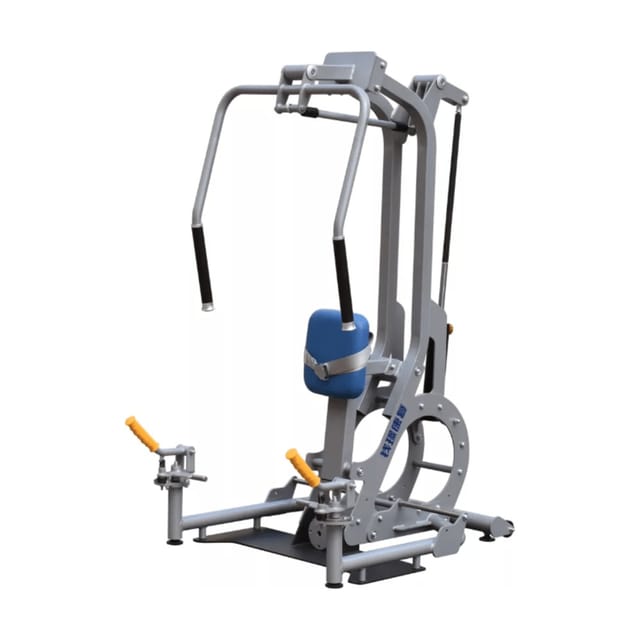
The CT3-H101 pairs the two foundational horizontal patterns — chest press and seated row — in one wheelchair-accessible station.
The open frame is the point of the machine. Users roll straight into the training position and begin, with no transfer, no assistance and no waiting for a staff member to become free. On a rehabilitation floor, that difference decides whether equipment gets used or gets walked past.
Pressing and rowing from the same station trains the chest, shoulders and triceps against the upper back, rear deltoids and biceps — the opposing pair that governs seated posture. This matters more for wheelchair users than for most populations: daily propulsion works the pushing muscles constantly and the pulling muscles barely at all, and the imbalance shows up as rounded shoulders and shoulder pain. Having both patterns in one place makes balanced programming straightforward.
Resistance runs from 35 N to 80 N across six positions — a deliberately light band, calibrated for rehabilitation, deconditioned and older users rather than performance training. Adjustment is made at the machine without tools, so users change their own setting between sets.
Every wear item carries a manufacturer part number, and the CT3-H101 shares its wear-part platform with the rest of the accessible range, so a single spares kit covers a full circuit.
Key features
Specifications
| Model | CT3-H101 |
|---|---|
| Series | Vertex CT3-H Accessible |
| Function | Chest press / seated row |
| Assembled size (L × W × H) | 121 × 122 × 174 cm |
| Floor footprint | 1.21 × 1.22 m |
| Resistance positions | 6 |
| Resistance range | 35 N – 80 N |
| Net weight | 115.5 kg |
| Gross weight | 129 kg |
| Carton size (L × W × H) | 1400 × 1000 × 400 mm |
| Shipping volume | 0.56 CBM |
| Application | Rehabilitation, physiotherapy, senior care, inclusive fitness |
- Home
- Strength Equipment
- CT3-H101 Chest Press / Row for Disabled person (Wheelchair Use)

CT3-H101 Chest Press / Row for Disabled person (Wheelchair Use)
| VARIANT | SELLER | PRICE | QUANTITY |
|---|
CT3-H101 Chest Press / Row for Disabled person (Wheelchair Use)
Description of product
The CT3-H101 pairs the two foundational horizontal patterns — chest press and seated row — in one wheelchair-accessible station.
The open frame is the point of the machine. Users roll straight into the training position and begin, with no transfer, no assistance and no waiting for a staff member to become free. On a rehabilitation floor, that difference decides whether equipment gets used or gets walked past.
Pressing and rowing from the same station trains the chest, shoulders and triceps against the upper back, rear deltoids and biceps — the opposing pair that governs seated posture. This matters more for wheelchair users than for most populations: daily propulsion works the pushing muscles constantly and the pulling muscles barely at all, and the imbalance shows up as rounded shoulders and shoulder pain. Having both patterns in one place makes balanced programming straightforward.
Resistance runs from 35 N to 80 N across six positions — a deliberately light band, calibrated for rehabilitation, deconditioned and older users rather than performance training. Adjustment is made at the machine without tools, so users change their own setting between sets.
Every wear item carries a manufacturer part number, and the CT3-H101 shares its wear-part platform with the rest of the accessible range, so a single spares kit covers a full circuit.
Key features
Specifications
| Model | CT3-H101 |
|---|---|
| Series | Vertex CT3-H Accessible |
| Function | Chest press / seated row |
| Assembled size (L × W × H) | 121 × 122 × 174 cm |
| Floor footprint | 1.21 × 1.22 m |
| Resistance positions | 6 |
| Resistance range | 35 N – 80 N |
| Net weight | 115.5 kg |
| Gross weight | 129 kg |
| Carton size (L × W × H) | 1400 × 1000 × 400 mm |
| Shipping volume | 0.56 CBM |
| Application | Rehabilitation, physiotherapy, senior care, inclusive fitness |
Related products
ABOUT THE SHOP
For 30 years, Afton has been building fitness ecosystems across India: home gyms, commercial gyms, physio and rehab centres, Pilates studios, corporate wellness spaces and hotels. We plan the space, choose the right equipment, install it and service it for years after. From treadmills, cross trainers, bikes and rowers to strength machines, racks, free weights, Pilates reformers and rehab equipment, we work with brands we trust, like SOLE, Spirit, Impulse, Xterra and REP. 50+ Afton dealers, expert installation and our own service teams across the country. AFTON. Where fitness gets engineered.
MY STORE
ADDRESS
2nd Floor, Jamaludeen Towers, 4 Montieth Road, Egmore
Chennai
Tamil Nadu - 600008
IN