-
Cardio Equipment
- Cardio Equipment
-
Weight Plates, Barbells & Kettlebells
- Weight Plates, Barbells & Kettlebells
-
Rehabilitation & Physiotherapy Equipment
- Rehabilitation & Physiotherapy Equipment
-
Gym Flooring
- Gym Flooring
-
HYROX Training Equipment
- HYROX Training Equipment
-
REP Fitness
- REP Fitness

Walking pad or treadmill? how to choose the right one for your home
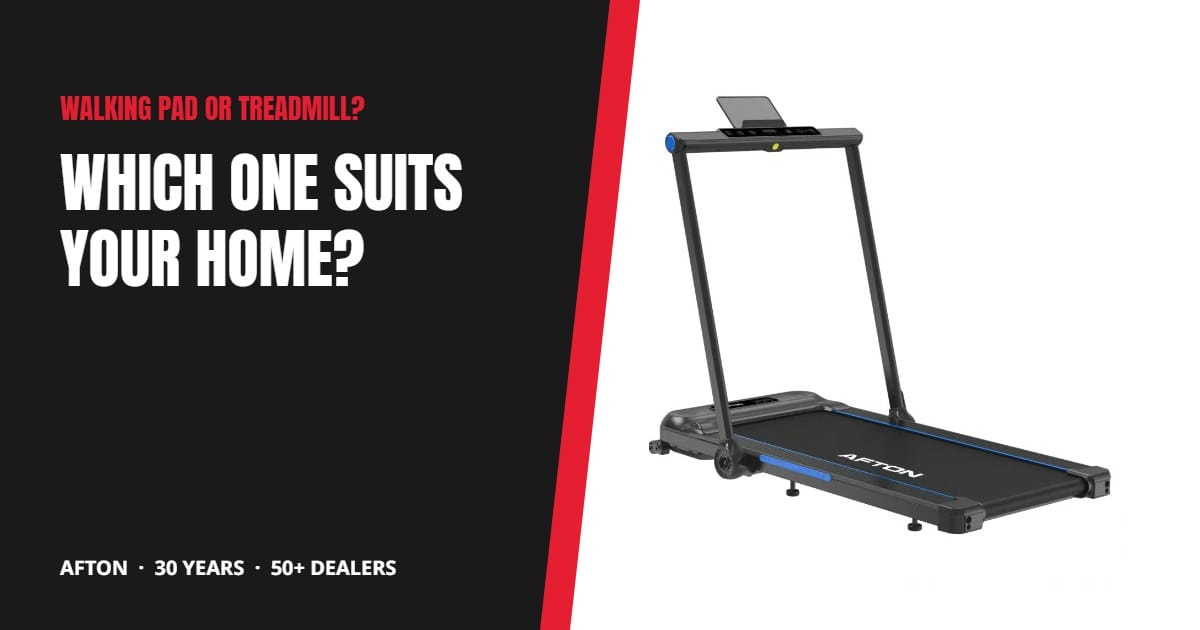
Walking pads have become one of the most asked-about pieces of home fitness equipment. They are slim, they slide under a bed or sofa, and they let you walk while you take calls or work at a standing desk. But they are not the same as a treadmill, and choosing the wrong one is a common and costly mistake.
After 30 years of helping Indian families and offices pick cardio equipment, here is our honest guide to which one suits you.
What is a walking pad?
A walking pad is a compact, low-profile motorised belt designed mainly for walking. Most have no tall handrails or large console. You control them with a small display or remote, and many fold flat or are thin enough to store under furniture.
For example, the Afton WP-10 Walking Pad has a 1.75 HP DC motor, a walking mode of 1 to 6 km/h, a running area of 420 x 1050 mm, supports users up to 100 kg, and folds flat for under-desk or under-bed storage. It also has a running mode up to 14 km/h for short jogs.
What makes a treadmill different?
A treadmill is built for walking, jogging and running. It usually has a wider and longer belt, a stronger motor, handrails, a console with programmes, and often motorised incline. That extra size and power is what lets you run safely at higher speeds and train for longer.
You will find foldable home models and heavier-duty options in our treadmills for home range.
Six questions to help you decide
1. Will you mostly walk, or do you want to run?
This is the most important question. If you want to walk 30 to 60 minutes a day at a steady pace, a walking pad does the job well. If you want to jog, run, do intervals or train for a race, choose a treadmill. A longer, wider belt gives you room for a natural running stride.
2. How much space do you have?
In a small flat, a walking pad is hard to beat. It can live under a bed or sofa and come out when you need it. A treadmill needs a permanent spot, plus clear space behind it for safety, even if it folds.
3. Do you want to walk while you work?
Walking while on calls or at a standing desk is one of the main reasons people buy walking pads. Some models are designed for exactly this. The Afton BT40 Walking Desk Treadmill is made for office and home use, with a 2 HP DC motor, a 450 x 1220 mm belt, a speed range of 1 to 16 km/h and a display that shows speed and pulse. Keep the speed slow and comfortable when you are typing. For ideas on how to use one through the working day, read our guide to zone 2 training on a walking pad.
4. Do you need handrails?
If you are older, recovering from an injury, or less steady on your feet, handrails matter. Most walking pads do not have them. In that case, a treadmill with full side rails is the safer choice. If balance is a concern, speak with your doctor or physiotherapist first.
5. Do you want incline?
Walking uphill raises the effort without needing to run, which is useful for fitness and for people who cannot run. Most walking pads are flat. If incline walking is part of your plan, look at treadmills with motorised incline.
6. Who will use it, and how often?
Check the maximum user weight and think about daily hours. If several family members will use it every day, or one person will use it for long sessions, a treadmill with a stronger motor and a bigger deck will last longer. For one person walking each day, a quality walking pad is fine.
Quick comparison
| Walking pad | Home treadmill | |
|---|---|---|
| Best for | Daily walking, walking while working | Walking, jogging, running, intervals |
| Space | Slides under a bed, sofa or desk | Needs a fixed spot (many fold) |
| Handrails | Usually none | Yes |
| Incline | Usually flat | Often motorised |
| Belt size | Compact | Longer and wider |
Tips to get the most from a walking pad
- Start slow. Begin at a gentle speed and build your time before your speed.
- Wear proper shoes. Walking barefoot or in socks for long periods is not ideal.
- Use a mat. A rubber floor mat protects your floor, reduces noise for neighbours and keeps the pad stable.
- Set up your desk properly. If you walk and work, raise your screen to eye level and keep your arms relaxed.
- Look after the belt. Follow the maintenance guidance in your manual, and keep the area free of dust.
Still not sure?
Many people start with a walking pad for daily steps and later add a treadmill or exercise bike for harder workouts. Others go straight to a treadmill because they know they want to run. There is no single right answer, only the right fit for your space, your body and your goals. You can also compare all our home cardio equipment.
The easiest way to decide is to try both. Visit an Afton store or speak to one of our 50+ Afton dealers, and we will help you test the feel, check the space in your home and arrange installation.
Talk to an Afton expert
Message us on WhatsApp with your city so we can connect you with your nearest Afton dealer.
Comments (0)

ABOUT THE SHOP
For 30 years, Afton has been building fitness ecosystems across India: home gyms, commercial gyms, physio and rehab centres, Pilates studios, corporate wellness spaces and hotels. We plan the space, choose the right equipment, install it and service it for years after. From treadmills, cross trainers, bikes and rowers to strength machines, racks, free weights, Pilates reformers and rehab equipment, we work with brands we trust, like SOLE, Spirit, Impulse, Xterra and REP. 50+ Afton dealers, expert installation and our own service teams across the country. AFTON. Where fitness gets engineered.
MY STORE
ADDRESS
2nd Floor, Jamaludeen Towers, 4 Montieth Road, Egmore
Chennai
Tamil Nadu - 600008
IN
Leave a Comment