-
Cardio Equipment
- Cardio Equipment
-
Weight Plates, Barbells & Kettlebells
- Weight Plates, Barbells & Kettlebells
-
Rehabilitation & Physiotherapy Equipment
- Rehabilitation & Physiotherapy Equipment
-
Gym Flooring
- Gym Flooring
-
HYROX Training Equipment
- HYROX Training Equipment
-
REP Fitness
- REP Fitness

Training for the tata mumbai marathon 2027 on a treadmill: an 11-week plan
Eleven weeks to race day
The Tata Mumbai Marathon 2027 is on Sunday, 17 January 2027, starting at Chhatrapati Shivaji Terminus. With over 70,000 participants across the full marathon, half marathon, Open 10K, Dream Run and Senior Citizens' Run, it is the biggest date on India's running calendar. Run clubs have grown fast across Indian cities this year, and many members are lining up for their first long race.
The problem is the next ten or eleven weeks. November and December bring smog in the north, late working hours everywhere, and early mornings that are hard to protect. A treadmill at home or in your society gym keeps your plan on track when the road is not an option. After 30 years of helping runners and gyms choose treadmills, here is how we suggest using one well.
Make the treadmill feel like the road
Set the incline to 1%
Running on a moving belt indoors is slightly easier than running outside, because there is no air resistance. A well-known study by Jones and Doust (1996) found that a 1% incline matched the energy cost of outdoor running for speeds between about 10.5 and 18 km/h. If you run slower than that, 0.5% is closer. Either way, do not run at 0% and assume it equals the road.
Practise race pace
The treadmill's biggest strength is control. You can lock in your goal pace exactly and teach your body what it feels like. Use this for your tempo runs and race-pace blocks.
Still do some running outside
Recent editions have taken runners over the Coastal Road and the Bandra-Worli Sea Link, with flyovers, camber and turns along the way. Try to do at least one run a week outdoors, ideally your long run, when air quality and time allow. The treadmill should carry most of the load, not all of it.
A simple 11-week structure
This is a framework for runners who can already run 5 to 10 km comfortably. Adjust the distances to your race: halve the long runs for the 10K, and stay close to these numbers for the half marathon. Full marathoners should follow a coach's plan with longer long runs.
Weeks 1 to 4: Build the base
- 3 to 4 runs a week, mostly at an easy pace where you can talk.
- One session of hill work on the treadmill: 6 to 8 rounds of 2 minutes at 4 to 6% incline, walk or jog 2 minutes flat in between. This builds strength for bridges and flyovers.
- Long run builds from 8 km to 12 km.
Weeks 5 to 8: Add race pace
- One tempo run a week: 15 to 25 minutes at a "comfortably hard" pace.
- One race-pace session: for example, 3 x 2 km at goal pace with 3 minutes easy jogging in between.
- Long run builds to 16 to 18 km for half marathoners. Practise your race-day drink and gel routine on these runs.
Weeks 9 to 10: Peak and hold
- Your longest run comes in week 9. In week 10, cut total distance by about a quarter.
- Keep one short race-pace session so your legs remember the rhythm.
Week 11: Taper
- Run 3 short, easy sessions with a few 1-minute pick-ups at race pace.
- Sleep, eat familiar food and rest your legs. You cannot gain fitness this week, but you can lose freshness.
Do not skip strength work
Most running injuries come from doing too much too soon, and weak hips and calves make it worse. Two short strength sessions a week help a lot: split squats, step-ups, glute bridges, single-leg calf raises and planks. A pair of dumbbells or a light barbell is plenty. Browse our strength equipment if your home gym needs a few basics.
What to look for in a treadmill for marathon training
If you are buying a treadmill for serious running, a few features matter far more than screens and apps.
- A continuous-duty motor. Long runs at steady speed put real load on the motor. A higher continuous rating runs cooler and lasts longer. AC motors are the standard for heavy and commercial use.
- Running surface length. Look for around 60 inches (about 152 cm) of length if you run at faster paces. Shorter decks feel cramped once your stride opens up.
- Incline range. At least 10 to 15 levels lets you do proper hill work.
- Top speed. Make sure the machine comfortably covers your fastest interval pace, not just your easy pace.
- Cushioning and a sturdy frame. Good cushioning reduces stress on the joints over many kilometres, and a solid frame keeps the belt stable at speed.
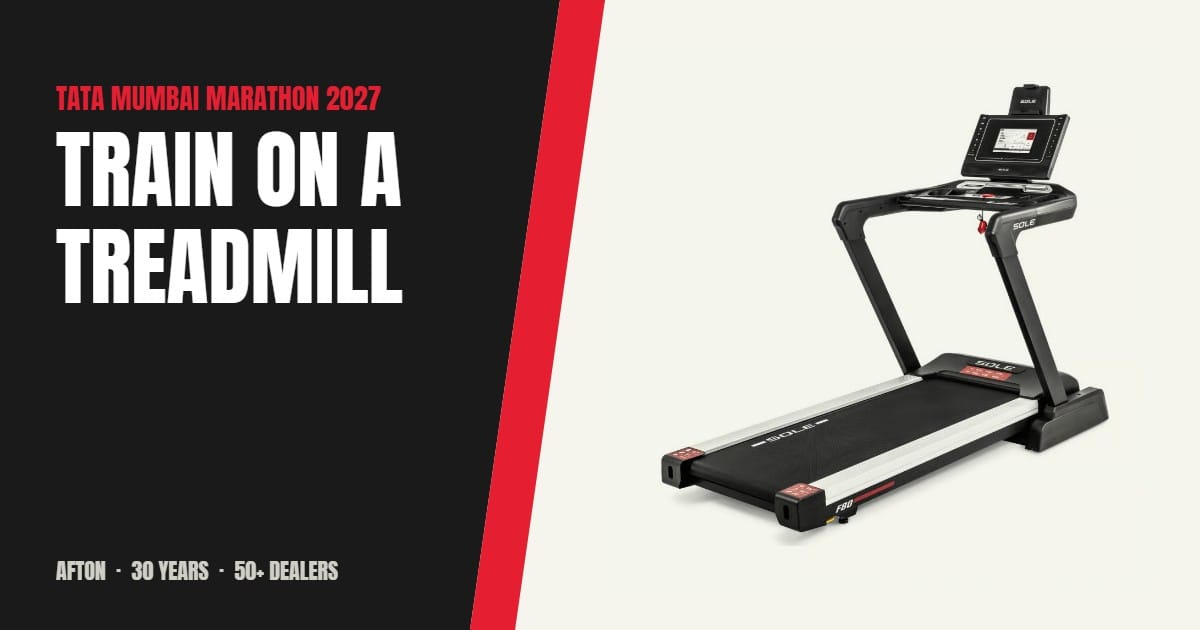
As an example, the SOLE F80 has a 3.5 HP motor, a 22 x 60 inch running surface, speeds up to 12 mph (about 19 km/h), 15 incline levels and a 350 lb user limit, and it folds when not in use. The SOLE F85 and Spirit XT385 are other strong home choices for runners. For society and corporate gyms where many runners share one machine, look at commercial models like the Impulse AC2990 or the Afton BT-570.
See the full range on our treadmills for home page, or compare commercial treadmills for gyms.
A quick word on safety
Always clip the safety key to your clothing, start the belt before stepping on, and keep a fan and water bottle nearby. Indoor runs feel hotter than outdoor ones. If you are over 40, new to running, or have any heart or blood pressure concerns, get a check-up before you start a training block.
Talk to Afton before race season
Choosing a treadmill now gives you ten clear weeks of training before 17 January. Our team and 50+ Afton dealers across India can help you pick the right machine for your pace, your space and your budget, and install it properly.
Chat with us on WhatsApp for advice on a treadmill for marathon training.
Find a store near you to try a treadmill before you buy.
Comments (0)

ABOUT THE SHOP
For 30 years, Afton has been building fitness ecosystems across India: home gyms, commercial gyms, physio and rehab centres, Pilates studios, corporate wellness spaces and hotels. We plan the space, choose the right equipment, install it and service it for years after. From treadmills, cross trainers, bikes and rowers to strength machines, racks, free weights, Pilates reformers and rehab equipment, we work with brands we trust, like SOLE, Spirit, Impulse, Xterra and REP. 50+ Afton dealers, expert installation and our own service teams across the country. AFTON. Where fitness gets engineered.
MY STORE
ADDRESS
2nd Floor, Jamaludeen Towers, 4 Montieth Road, Egmore
Chennai
Tamil Nadu - 600008
IN
Leave a Comment