-
Cardio Equipment
- Cardio Equipment
-
Weight Plates, Barbells & Kettlebells
- Weight Plates, Barbells & Kettlebells
-
Rehabilitation & Physiotherapy Equipment
- Rehabilitation & Physiotherapy Equipment
-
Gym Flooring
- Gym Flooring
-
HYROX Training Equipment
- HYROX Training Equipment
-
REP Fitness
- REP Fitness

Stair climbers are trending: workouts, benefits and how to choose one
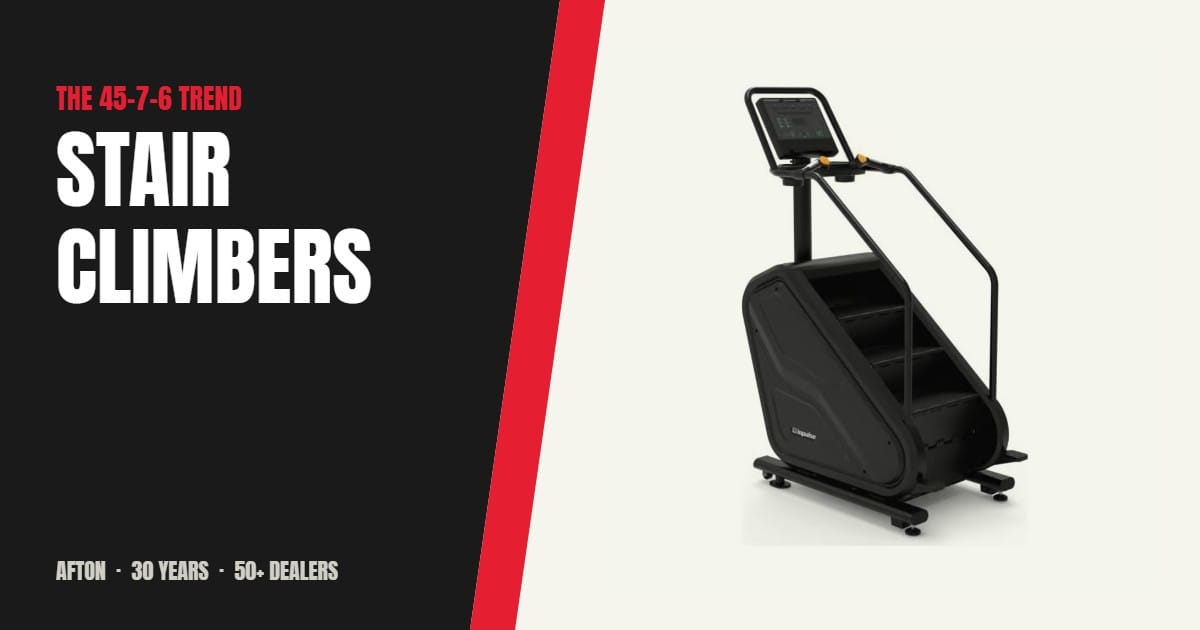
Why everyone is suddenly talking about the stair climber
Walk into any busy gym in Mumbai, Bengaluru or Delhi in the evening and you will probably find a queue at the stair climber. Social media has a lot to do with it. Workouts like the "45-7-6" (45 minutes, level 7, six days a week) keep circulating with before-and-after photos, and Google has flagged searches for it as a breakout term. We see the same interest in India: searches for "stair master machine", "stair climber machine" and "stairmaster for home" have grown into some of the most active cardio searches reaching Afton this autumn.
After 30 years of fitting out home gyms and commercial floors, we think the stair climber deserves the attention, but not the hype. Here is what it does well, how to use it sensibly, and how to choose the right one for a home or a gym.
What a stair climber actually does for you
A stair climber is a short, motorised staircase that keeps moving under your feet. You climb at a steady rate, so every step lifts your full body weight. That makes it different from a treadmill or an elliptical in three useful ways.
1. Big cardio return in a short time
Climbing pushes your heart rate up quickly. Researchers at McMaster University (Allison and colleagues, 2017) had sedentary young women do just three 20-second bursts of hard stair climbing, three days a week. After six weeks their peak aerobic fitness (VO2peak) rose by about 12%. A second group doing three 60-second climbs improved by about 7%. You do not need 45 minutes to get fitter.
2. Lower-body strength without pounding
Each step works the glutes, quads and calves through a range similar to a step-up. There is no landing impact like running, which is why trainers often recommend it for people who find road running hard on their knees. It is not a replacement for squats or deadlifts, but it is a strong partner to them.
3. It trains you for real life
Stairs are everywhere in Indian life: metro stations, temples, old apartment buildings without lifts, hill treks. Being able to climb comfortably is one of the most practical kinds of fitness there is, at any age.
What the 45-7-6 trend gets right, and what it misses
It gets consistency right. Showing up six days a week for steady cardio will change your fitness. But 45 minutes at a fixed level every day is a big jump for most people, and trainers quoted on the trend describe it as best suited to people who already train regularly. Start lower and build up.
A sensible progression looks like this:
- Weeks 1 to 2: 10 to 15 minutes at an easy pace, three days a week. You should be able to talk in full sentences.
- Weeks 3 to 4: 20 minutes, add a fourth day. Keep most sessions easy.
- Week 5 onwards: 25 to 35 minutes on easy days, plus one interval day: 6 to 8 rounds of 30 seconds faster, 90 seconds slow.
Two form tips matter more than the level number. Stand tall and keep only a light touch on the handrails; leaning on them takes the work away from your legs. And place your whole foot on each step, pushing through the heel, so your glutes do their share.
Stair climber, stepper or vertical climber?
These three machines get mixed up, and they suit different people.
- Stair climber (revolving staircase): Real steps that rotate. The closest thing to climbing stairs and the most demanding. Ideal for commercial gyms, hotels and serious home gyms.
- Stepper: Two pedals that move up and down. Smaller and quieter, with a shorter range of motion. A good fit for apartments.
- Vertical climber: Arms and legs move together, like climbing a ladder. A full-body option that is very popular in HYROX and functional zones.
Choosing the right machine
For a commercial gym, hotel or residential society
Look at the step-speed range, the maximum user weight and the step height. The Impulse XSC500 Stair Climber, for example, runs from 25 to 158 steps per minute and is rated for users up to 160 kg, with climbing, interval, heart-rate and custom programs. The Spirit Fitness CSC900 goes up to 168 steps per minute with a commercial-grade steel frame and 10 preset workouts. For larger floors, the Impulse XSC700, Impulse XSC750 and Spirit CSC980 are worth comparing.
Plan the space carefully. A stair climber like the XSC500 stands about 2.15 metres tall, and the user climbs higher still, so check your ceiling height before you order. We suggest at least 2.7 metres of clear height for most commercial models.
For a home
Most homes are better served by a stepper or a vertical climber because of height and space. The Spirit Fitness CS800+ Stepper and the Spirit CRS800S+ Recumbent Stepper are good options. The recumbent stepper is seated, which makes it a kind choice for older family members or anyone coming back from a knee or back problem. If you want a full-body workout, look at the SOLE CC81 Cardio Climber or the Versaclimber LX.
You can compare every model on our stair climbers and vertical climbers page, or browse the wider cardio equipment range.
Who should be careful
Stair climbing is low impact, but it is not low effort. If you have a heart condition, high blood pressure, or a recent knee, hip or ankle injury, check with your doctor or physiotherapist first and start at the slowest speed. Older users should always use the handrails for balance, even if they are only resting a hand on them.
Our take
The stair climber is popular for a good reason: it gives a lot of fitness for the time you put in, it is kind to the joints, and it builds legs that cope with real life. The trend will cool down, but the machine will stay useful. For a gym owner, it is one of the cardio pieces members actually queue for. For a home, the right choice depends on your ceiling, your space and who in the family will use it.
Our team and 50+ Afton dealers across India can help you pick the right climber, check your space and install it properly.
Talk to Afton
Chat with us on WhatsApp to get advice on the right stair climber or stepper for your home or gym.
Find a dealer near you to try one in person.
Comments (0)

ABOUT THE SHOP
For 30 years, Afton has been building fitness ecosystems across India: home gyms, commercial gyms, physio and rehab centres, Pilates studios, corporate wellness spaces and hotels. We plan the space, choose the right equipment, install it and service it for years after. From treadmills, cross trainers, bikes and rowers to strength machines, racks, free weights, Pilates reformers and rehab equipment, we work with brands we trust, like SOLE, Spirit, Impulse, Xterra and REP. 50+ Afton dealers, expert installation and our own service teams across the country. AFTON. Where fitness gets engineered.
MY STORE
ADDRESS
2nd Floor, Jamaludeen Towers, 4 Montieth Road, Egmore
Chennai
Tamil Nadu - 600008
IN
Leave a Comment